
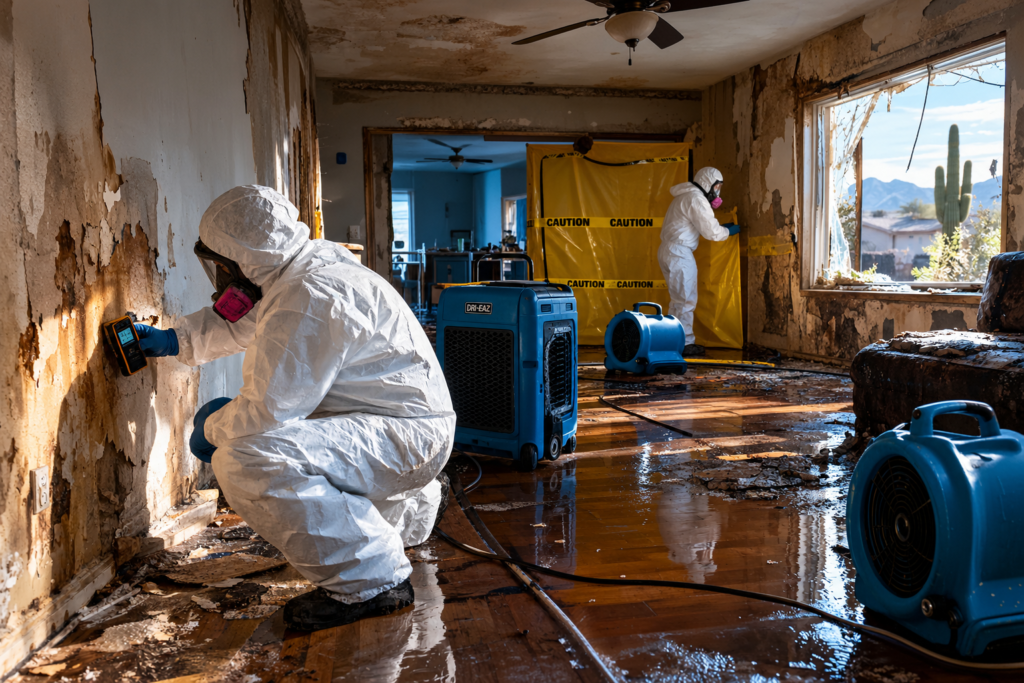
When disaster strikes a Phoenix property, it rarely arrives alone. A burst pipe that soaks a wall can turn into a mold and biohazard situation within 24 hours. A sewage backup floods not just floors but entire living spaces with dangerous pathogens. A storm that drives water through a roof can expose insulation laced with years of accumulated toxins.
In these scenarios, standard water extraction is not enough and a hazard cleanup company working alone is not enough either. What properties like these require is a coordinated dual-restoration process: one that handles structural water damage and biological or chemical hazard contamination in the right sequence, without skipping steps.
This guide walks you through the five-step process that professional restoration teams follow when a property requires both water damage restoration and hazard cleanup and why cutting corners on any step creates long-term liability for property owners.
Important: Water damage and hazard contamination together represent a compounded emergency. Every hour of delay allows moisture to spread, microbial growth to accelerate, and hazardous materials to migrate further into a structure. Do not attempt to combine both cleanups as a DIY project.
Emergency Assessment & Hazard Identification
Before a single pump runs or a single piece of PPE is removed, professionals conduct a thorough dual assessment of the property. This is not just a walkthrough it is a systematic process that maps both the moisture intrusion and any hazardous materials present.
What happens during assessment:
- Thermal imaging and moisture meters map the full extent of water penetration behind walls, under flooring, and inside structural cavities.
- The water source is categorized: Category 1 (clean water), Category 2 (gray water with contaminants), or Category 3 (black water sewage, floodwater, or other grossly contaminated water).
- Hazard-specific testing identifies whether mold, asbestos, lead paint, sewage pathogens, chemical residues, or biological waste is present.
- Air quality samples are taken in affected zones to establish baseline contamination levels.
- The structural integrity of affected walls, floors, and ceilings is evaluated water-saturated drywall that also contains hazardous materials must be handled and disposed of according to strict protocols.
This step determines the order of operations for everything that follows. Skipping it means crews could inadvertently spread contamination by running fans and dehumidifiers before hazardous material containment is established.
Containment & Safety Protocols Before Any Water Work Begins
This is the step most homeowners and unfortunately, some less-experienced contractors skip when they’re eager to start drying. It is also the step that separates certified restoration professionals from general contractors.
If hazardous materials (mold colonies, sewage contaminants, asbestos-containing materials, biohazard waste) are present, they must be physically contained before water mitigation equipment is activated. Here’s why: dehumidifiers and air movers circulate large volumes of air. If that air carries mold spores, pathogens, or asbestos fibers, those particles get distributed throughout the structure and potentially beyond it.
Containment protocols include:
- Poly sheeting barriers with negative air pressure containment zones isolating hazardous areas from clean zones.
- HEPA-filtered air scrubbers placed within containment to capture airborne particles during any disturbance.
- Decontamination chambers (airlocks) for crews entering and exiting hazardous zones to prevent cross-contamination.
- Utility shutoffs, when necessary, to prevent additional water entry or spreading of contaminated water through a building’s systems.
- Documentation of all hazardous materials for regulatory compliance and insurance reporting.
Phoenix-Specific Note: Arizona’s heat accelerates mold development dramatically. At Phoenix’s average summer temperatures, mold colonization can begin in as little as 24–48 hours in moisture-compromised structures. Properties with existing mold combined with active water intrusion require containment as an immediate priority, not an afterthought.
Hazard Remediation & Removal First
In the professional dual-restoration process, hazard remediation precedes full water mitigation. The reasoning is straightforward: you cannot effectively dry or restore materials that are contaminated and scheduled for removal. Restoring structure that still contains hazardous waste is not restoration it is concealment.
This phase involves:
- Sewage & biohazard removal: All solid waste, contaminated materials, and Category 3 water is safely extracted and disposed of per EPA and local Arizona DEQ regulations. Affected porous materials drywall, insulation, carpet are typically removed entirely.
- Mold remediation: Mold-infested structural materials are carefully removed within containment, HEPA-vacuumed, and the substrate treated with EPA-registered antimicrobial agents. Air quality testing confirms clearance before containment is broken.
- Asbestos or lead abatement: If assessment revealed ACM (asbestos-containing materials) or lead paint in water-affected areas, licensed abatement contractors handle removal under strict OSHA and NESHAP protocols before any structural drying begins.
- Chemical hazard neutralization: In commercial properties or cases involving industrial chemicals, professionals neutralize and safely remove contaminated materials before water restoration proceeds.
This phase leaves behind a structurally exposed but safe environment one where the remaining materials can be properly dried and restored without contamination risk.
For more context on how water damage severity is categorized and why the water source determines the appropriate cleanup response, the water damage restoration specialists at Lake Charles LA Water Damage have published detailed resources on contamination classification and professional mitigation standards that apply across restoration industry best practices.
Water Damage Extraction, Structural Drying & Dehumidification
With hazardous materials removed and containment cleared, full water restoration work can proceed safely. This is where the science of psychrometrics the study of air and moisture interaction drives every decision professionals make.
What professional water restoration at this stage includes:
- Bulk water extraction: Commercial-grade truck-mounted or portable extractors remove standing water from all affected areas. Subfloor spaces, wall cavities, and crawl spaces are addressed separately using specialized extraction tools.
- Structural drying with drying chambers: Rather than placing random fans throughout the property, restoration professionals create calculated drying systems controlling airflow velocity, temperature, and humidity across a defined drying zone. This reduces dry-out time from weeks to days.
- Dehumidification: Industrial LGR (low-grain refrigerant) dehumidifiers pull moisture from the air and from materials simultaneously. Professionals calculate required dehumidification capacity based on affected square footage and moisture readings not guesswork.
- Daily moisture monitoring: Technicians return daily to log moisture readings across all affected materials, adjust drying equipment placement, and document progress providing data for insurance claims and verifying that materials have reached dry standard before reconstruction begins.
- Antimicrobial treatment: Following extraction, exposed structural materials are treated with EPA-registered antimicrobial products to prevent secondary mold growth during the drying phase.
This is the most equipment-intensive phase of the process. Professional restoration companies use moisture mapping software to document every reading, creating a chain of evidence that satisfies insurance adjusters and confirms the thoroughness of the drying process.
Understanding the difference between clean water events and contaminated water events is essential for property owners working with insurance. Restoration professionals serving areas like Lake Charles and surrounding Louisiana communities frequently handle large-scale water events where contamination classification determines both the scope of cleanup and coverage outcomes the same principles apply in Phoenix flood and sewage events.
Post-Remediation Testing, Clearance & Rebuild Coordination
The final step is the one that legally and practically closes both the hazard remediation and water restoration phases and it is the step that distinguishes certified professionals from companies that simply “clean up and leave.”
Post-remediation clearance includes:
- Air quality clearance testing: Conducted by a third-party industrial hygienist (IH), not the remediation company itself, to verify that airborne contaminant levels are within acceptable limits. This is required for mold, asbestos, and certain biohazard situations before reconstruction can begin.
- Final moisture verification: All previously wet structural materials framing, subfloor, concrete, wall cavities must reach regional equilibrium moisture content (EMC) before reconstruction. In Phoenix’s dry climate, this typically means very low moisture targets that must be documented.
- Written clearance documentation: Clearance reports, lab results, and final moisture logs are compiled into a complete project file. This documentation is essential for insurance claims, property resale disclosure, and tenant protection in rental properties.
- Reconstruction coordination: Restoration companies hand off to licensed general contractors with a full scope-of-work document specifying exactly what materials were removed, what remained, and what structural repairs are required before finishes are applied.
- Follow-up inspection: Reputable restoration companies schedule a follow-up inspection 30–60 days post-completion to verify no moisture issues have recurred and no secondary mold growth has developed.
Skipping clearance testing to save money or time is one of the most costly mistakes a property owner can make. Re-contamination after incomplete remediation, or moisture issues discovered during a future sale’s inspection, cost dramatically more to address than proper clearance testing at the time of restoration.
Why Phoenix Properties Face Unique Combined-Damage Risks
Phoenix’s desert climate creates a counterintuitive hazard: because properties go long stretches without significant moisture, building materials and HVAC systems are often not designed or maintained with moisture management in mind. When water intrusion does occur from monsoon flooding, pipe failures, or roof damage affected materials often lack the protective coatings or moisture barriers common in humid-climate construction.
The result is that water damage in Phoenix properties tends to be more severe per gallon of water involved, and mold colonization can occur faster in neglected or poorly ventilated spaces than in comparable events in wetter climates. Combined with older construction that may contain asbestos, lead paint, or vermiculite insulation, many Phoenix water events quickly escalate into dual water-and-hazard situations that require the exact five-step professional process described above.
Choosing the Right Restoration Partner in Phoenix
Not every contractor who performs water damage restoration is equipped or certified to handle hazardous materials and not every hazard cleanup company has the equipment and training for structural drying. When a Phoenix property needs both, look for:
- IICRC certification in Water Damage Restoration (WRT) and Applied Structural Drying (ASD).
- Arizona-licensed hazardous materials handling credentials.
- The ability to perform or coordinate third-party clearance testing.
- Full documentation practices, including moisture logs, lab results, and photo evidence for insurance purposes.
- Experience with both residential and commercial combined-damage projects in the greater Phoenix metro area.
Dealing With Water Damage & Hazardous Contamination in Phoenix?
Our certified team handles both with the right sequence, the right equipment, and complete documentation from day one to clearance.← Back to Hazard Cleanup Phoenix Home
Leave a Reply