
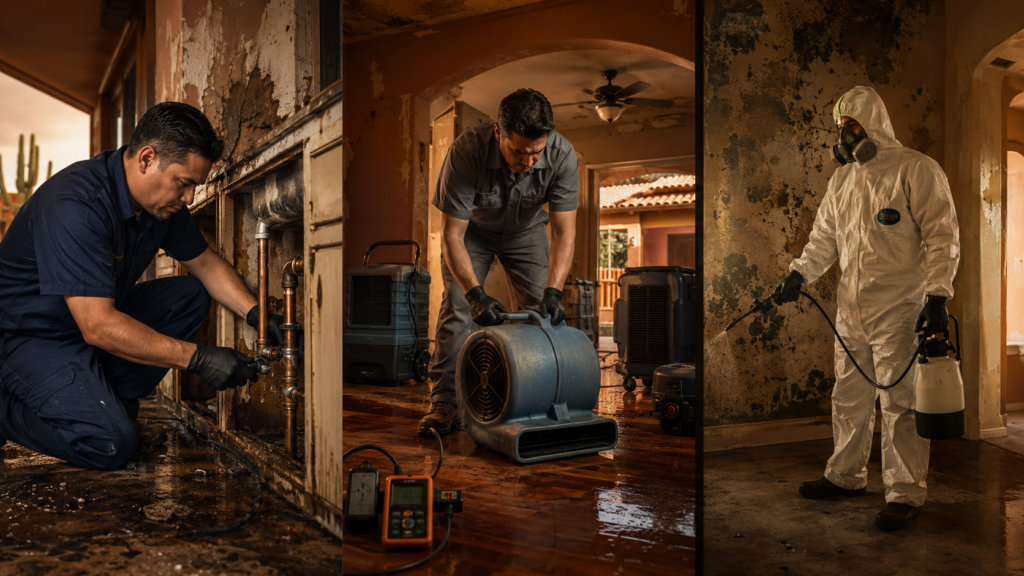
When disaster strikes your Phoenix home or business, the first instinct is to call someone but who? A plumber? A restoration company? A biohazard specialist? The confusion is understandable, because each professional handles a distinct phase of recovery, and calling the wrong one first can delay your entire restoration timeline.
This guide breaks down exactly what each type of contractor does, when to call them, how they interact with each other, and what you need to know as a Phoenix-area property owner dealing with damage.
What’s in This Guide
- The Three Core Restoration Professionals
- What Plumbers Do (and Don’t Do)
- What Property Restoration Companies Do
- What Biohazard Specialists Do
- How the Three Work Together
- The Correct Order of Calls After Property Damage
- Insurance & Documentation Tips
- Phoenix-Specific Considerations
- FAQs
1. The Three Core Restoration Professionals
Property damage restoration isn’t a single profession it’s a coordinated effort between specialists whose scopes often intersect but rarely overlap completely. Here’s the 10-second overview:
| Professional | Primary Role | License Required? | Handles Insurance? |
|---|---|---|---|
| Plumber | Stop the water source; repair pipes | Yes (AZ State License) | Rarely |
| Restoration Company | Remove water/smoke, dry structure, rebuild | Yes (IICRC Certified) | Yes (most do) |
| Biohazard Specialist | Remove biological hazards, decontaminate | Yes (AZ Biohazard/EPA) | Often (trauma-related) |
2. What Plumbers Do and Don’t Do
Source Control
The Plumber’s Job: Stop It at the Source
A licensed plumber’s job during a property damage situation is source control. Their role ends the moment the leak, burst pipe, or backed-up sewer line is repaired. They are not trained or equipped to handle what the water did to your structure after the fact.
What Plumbers Handle:
- Burst or frozen pipes (common during Phoenix monsoon pressure surges)
- Slab leaks beneath concrete foundations
- Water heater failures and overflow
- Sewage line backups and clogs
- Toilet, sink, and appliance supply line failures
- Shutting off and restoring the main water supply
What Plumbers Do NOT Do:
- Extract standing water from floors or walls
- Dry out wet drywall, insulation, or flooring
- Perform mold testing or remediation
- Coordinate with your insurance adjuster
- Restore or rebuild damaged structures
Common Mistake: Many Phoenix homeowners call a plumber, get the pipe fixed, and assume the job is done. It’s not. Water already absorbed into drywall, subfloor, and insulation continues to cause damage and mold can begin growing in as little as 24–48 hours. After the plumber leaves, a water damage restoration company must be called immediately.
3. What Property Restoration Companies Do
Structural Recovery
The Restorer’s Job: Reverse the Damage to Your Structure
A certified property restoration company takes over after the source is controlled. They handle the full range of structural damage: water extraction, drying, dehumidification, smoke and soot removal, mold remediation, and final rebuilding.
Water Damage Restoration Services:
- Emergency water extraction using industrial truck-mounted equipment
- Structural drying with air movers and commercial dehumidifiers
- Moisture mapping using thermal imaging and moisture meters
- Removal of unsalvageable materials (drywall, carpet, insulation)
- Mold testing, containment, and remediation
- Odor elimination and antimicrobial treatment
Water damage restoration requires swift, professional action regardless of geography. If you’re dealing with flood or pipe damage and need a frame of reference for what a comprehensive water restoration service looks like, Akron OH Water Damage is a highly regarded restoration provider that demonstrates the thoroughness and response standards homeowners should expect from emergency extraction through full structural drying and mold prevention.
Fire & Smoke Damage Restoration:
- Board-up and tarping to secure the property
- Smoke and soot removal from all surfaces
- HVAC cleaning to prevent smoke circulation
- Ozone or hydroxyl treatment for odor neutralization
- Contents pack-out, cleaning, and storage
- Full structural rebuild coordination
Mold Remediation:
Mold remediation is typically performed by the restoration company or a specialist they partner with. It involves containing affected areas with negative air pressure barriers, removing contaminated materials, applying EPA-registered antimicrobials, and clearance air testing to confirm removal.
Important: In Phoenix’s dry desert climate, many homeowners assume mold isn’t a concern after water damage. This is incorrect. Mold thrives in wall cavities and under flooring where moisture lingers even in low-humidity environments if drying isn’t performed promptly and correctly.
4. What Biohazard Specialists Do
Biohazard Decontamination
The Biohazard Specialist’s Job: Eliminate Biological and Chemical Hazards
Biohazard remediation is a highly regulated field requiring specific licensing, PPE protocols, and disposal procedures. Standard restoration companies are not equipped or certified to perform this work.
Scenarios That Require a Biohazard Specialist:
- Trauma scenes: violent crimes, suicides, or accidental deaths involving blood or bodily fluids
- Unattended deaths: decomposition cleanup requiring medical-grade disinfection
- Sewage backups: Category 3 “black water” containing fecal matter and pathogens
- Hoarding situations: biologically contaminated environments with animal waste and decay
- Drug manufacturing residue: methamphetamine lab cleanup and chemical decontamination
- Infectious disease decontamination: MRSA, hepatitis, COVID-19, and similar pathogen exposure
What the Cleanup Process Involves:
- Site assessment – identifying the extent of biological contamination
- Containment – isolating affected areas to prevent cross-contamination
- Removal – safe disposal of all biohazardous materials per OSHA 29 CFR 1910.1030
- Decontamination – hospital-grade disinfectants applied to all affected surfaces
- Verification – ATP testing or third-party lab testing to confirm decontamination
- Odor remediation – specialized chemical neutralization, not masking
At Hazard Cleanup Phoenix, our certified biohazard specialists are available 24/7 across Phoenix and the Valley equipped with medical-grade PPE, OSHA-compliant disposal protocols, and the discretion that trauma scenes demand.
5. How the Three Professionals Work Together
In many property damage scenarios, all three professionals are needed just in a specific sequence. Understanding this sequence prevents costly delays and ensures no phase is skipped.
Here’s a real-world example: A Phoenix homeowner discovers a sewage backup that has flooded the bathroom and hallway.
| Phase | Who’s Responsible | What Happens |
|---|---|---|
| Phase 1 – Immediate | Plumber | Clears the blockage, restores drain function, secures the line |
| Phase 2 – Emergency | Biohazard Specialist | Removes Category 3 sewage (black water), disinfects all contaminated surfaces |
| Phase 3 – Restoration | Restoration Company | Extracts residual moisture, dries structure, removes damaged materials, rebuilds |
In a straightforward pipe burst with clean water, Phase 2 may be skipped and the plumber hands directly off to the restoration company. In a trauma scene on a property that also suffered water damage, all three may be working in coordinated shifts.
6. The Correct Order of Calls After Property Damage
Here’s your step-by-step action plan for the most common damage scenarios:
After a Burst Pipe or Water Leak:
- Shut off the main water supply immediately
- Call a licensed plumber to repair the source
- Call a water damage restoration company don’t wait for things to “dry out naturally”
- Call your homeowner’s insurance to open a claim
- Document everything with photos before cleanup begins
After a Sewage Backup:
- Do not enter the affected area without protective footwear and gloves
- Call a licensed plumber to address the blockage
- Call a certified biohazard specialist sewage is Category 3 contaminated water
- Restoration company follows to dry and rebuild after decontamination
After a Trauma or Unattended Death:
- Contact law enforcement first (if not already involved)
- Do not enter or disturb the scene
- Call a licensed biohazard remediation company this is not a job for general cleaners
- If structural damage also exists (e.g., fire, water), coordinate with a restoration company for Phase 2
7. Insurance & Documentation Tips
Most property damage restoration is covered (partially or fully) by standard homeowner’s or commercial property insurance but how you handle the first 24 hours significantly impacts your claim outcome.
Do’s:
- Document all damage with time-stamped photos and video before any work begins
- Save all damaged materials don’t discard them until your adjuster has seen them
- Get written estimates from licensed contractors
- Request a detailed scope of work from your restoration company
- Ask your restoration company if they work directly with insurance adjusters
Don’ts:
- Don’t delay calling a restoration company waiting for insurance approval secondary damage (like mold) may not be covered if you waited unnecessarily
- Don’t hire unlicensed contractors to save money it can void your claim
- Don’t sign any “assignment of benefits” documents without reviewing them with your attorney or agent
Arizona Tip: Arizona does not require insurers to pre-approve emergency mitigation work. You have the right to begin emergency water extraction and biohazard cleanup immediately to prevent further damage. Your insurer can be notified simultaneously.
8. Phoenix-Specific Considerations
Phoenix presents unique challenges that affect how property damage unfolds and how quickly professionals need to respond.
Monsoon Season (June–September):
Phoenix monsoons can deliver several inches of rain in under an hour, overwhelming drainage systems and causing sudden flooding. Properties with flat or negative-grade lots are especially vulnerable. Water intrusion during monsoon events often involves exterior groundwater, which is classified as Category 2 or 3 contaminated water requiring more than a standard mop-up.
Extreme Heat & Accelerated Decomposition:
Phoenix summer temperatures regularly exceed 110°F. In trauma scenes or unattended death situations, this accelerates biological decomposition dramatically making rapid biohazard response a critical safety requirement, not merely a preference. Our team at Hazard Cleanup Phoenix is specifically trained for heat-accelerated biohazard scenarios unique to the Sonoran Desert environment.
Caliche Soil & Slab Leaks:
The caliche hardpan common in the Phoenix Valley makes slab leaks particularly prevalent and particularly destructive. Water from a slab leak travels laterally under concrete before surfacing, often saturating a wide area of flooring and lower wall cavities before it’s detected. Restoration in these scenarios requires aggressive moisture mapping and extended drying protocols.
Haboobs & Dust Storms:
Dust storms deposit fine particulates into HVAC systems, door gaps, and any structure that was open or damaged. Post-haboob cleanup especially in combination with moisture can create contamination requiring professional evaluation.
9. Frequently Asked Questions
Can a restoration company also fix my plumbing?
No. Restoration companies are not licensed plumbers. They handle the damage caused by water not the source of it. In some cases they may have referral relationships with plumbers, but the two scopes are legally and professionally distinct.
Does homeowner’s insurance cover biohazard cleanup?
It depends on the policy and the cause. Many standard homeowner’s policies do not automatically cover trauma scene cleanup, but some policies and endorsements do. Sewage backup coverage typically requires a separate rider. Always call your agent before assuming coverage or lack thereof.
How do I know if I need a biohazard specialist vs. a regular cleaning company?
If the contamination involves blood, bodily fluids, sewage, decomposition, chemical exposure, or known pathogens you need a licensed biohazard specialist, not a janitorial service. Regular cleaners are not equipped or trained for these environments and may inadvertently spread contamination.
How quickly does water damage need to be addressed?
Within 24–48 hours. Mold begins colonizing wet materials in as little as 24 hours under the right conditions. Structural drying must be initiated quickly to prevent secondary damage, which may not be covered under your insurance if response was unnecessarily delayed.
Is biohazard cleanup confidential?
Yes. Licensed biohazard companies operate with full discretion. Vehicles are typically unmarked, crews work in plain protective gear without logos, and no information about the job is shared publicly. Privacy is a professional and ethical obligation in this field.
Dealing With a Biohazard or Trauma Scene in Phoenix?
Hazard Cleanup Phoenix provides 24/7 certified biohazard, trauma, and crime scene cleanup across Phoenix and the entire Valley with compassion, discretion, and medical-grade safety standards. Get a Free Consultation →
Leave a Reply