
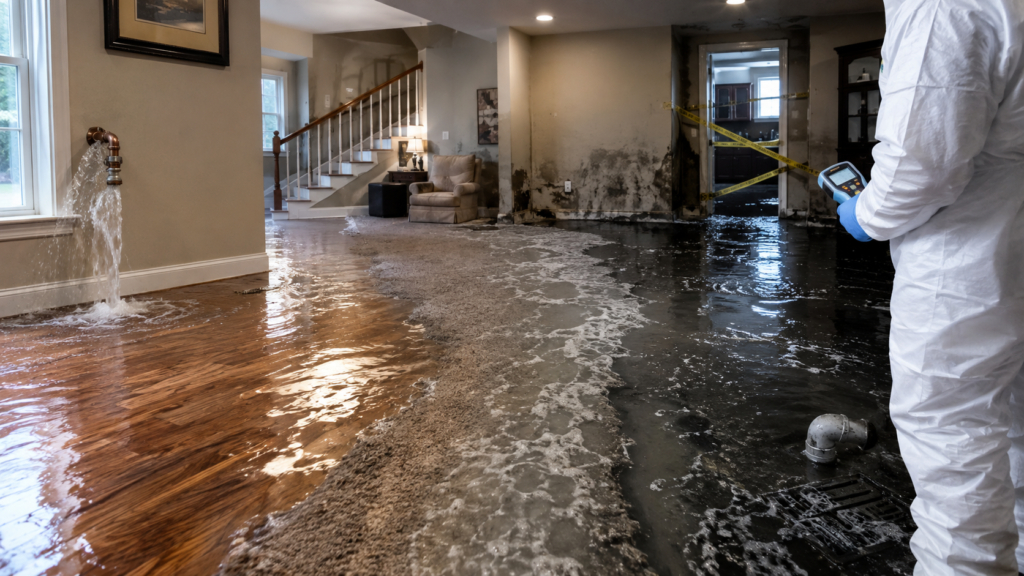
A burst pipe under the kitchen sink. A washing machine hose that finally gave out. A toilet that overflowed while you were at work. At first glance, water damage is water damage wet floors, soaked walls, and a ruined morning.
But not all water damage is the same. In fact, the water entering your home right now may have already crossed from a simple cleanup job into full biohazard territory and most homeowners have no idea until it is too late.
The restoration industry uses a three-tier classification system, defined by the IICRC S500 Standard for Professional Water Damage Restoration, to describe exactly how contaminated water is and what level of response it requires. Those three tiers Category 1, Category 2, and Category 3 determine everything: what gear technicians must wear, what building materials must be torn out, what disinfection protocols apply, and whether your family can safely remain in the home during cleanup.
At Hazard Cleanup Phoenix, we respond to the full spectrum of biohazard and contamination events across the Valley. Water damage that escalates into Category 3 is, by regulatory definition, a biohazard incident — and it demands the same care and expertise we bring to crime scene and trauma remediation. Here is what every homeowner needs to know before the next water event hits.
The IICRC Classification System: Why Categories Matter
The Institute of Inspection, Cleaning and Restoration Certification (IICRC) developed the S500 Standard to give restoration professionals and property owners a consistent language for describing the severity and contamination level of any water loss.
The category is not about how much water is present. It is about how safe that water is to be around. A small sewage backup in a half-bath is categorically more dangerous than a flooded basement from a broken supply line, even though the flooded basement involves far more water volume.
Understanding the category determines:
- Whether building materials can be dried and salvaged or must be demolished and discarded
- What personal protective equipment (PPE) technicians are legally required to wear
- Whether the space must be contained and isolated from the rest of the home
- How long you and your family should stay out of the affected area
- What your insurance claim documentation needs to reflect
Category 1: Clean Water The Starting Point
What it is: Category 1 water originates from a sanitary source and poses no substantial risk from skin contact, ingestion, or inhalation at the time of release.
Common sources include:
- Broken or burst clean water supply lines
- Overflowing bathroom sinks or bathtubs (with no contaminants added)
- Malfunctioning ice maker or dishwasher supply lines
- Rainwater entering through a roof leak or broken window
- Toilet tank overflow (not the bowl the tank only)
What it means for cleanup: Category 1 is the most manageable scenario. A fast-responding restoration company can typically save affected drywall, carpet, and subfloor materials through professional drying and dehumidification. No hazmat gear is required. The health risk to occupants is minimal as long as drying begins within 24 to 48 hours.
The critical catch Category 1 does not stay Category 1 for long.
Clean water begins deteriorating the moment it leaves its source. Once it contacts building materials drywall paper, carpet backing, subfloor wood, insulation it picks up organic matter, dust, and contaminants. Within 24 to 48 hours, standing Category 1 water can degrade to Category 2. Within 48 to 72 hours, especially in warm environments like a Phoenix home in summer, it can reach Category 3.
Time is not on your side. A Category 1 event that goes unaddressed over a long weekend can become a biohazard scenario by Monday morning.
Category 2: Grey Water Contamination Begins
What it is: Category 2 water contains significant contamination that has the potential to cause discomfort or illness if a person is exposed to or ingests it. The IICRC defines this water as carrying a “significant level of contamination” beyond a sanitary source.
Common sources include:
- Toilet overflow containing urine but no feces
- Dishwasher or washing machine discharge water
- Aquarium or waterbed leak
- Sump pump backup
- Water that has seeped through a concrete slab and contacted soil
- Category 1 water that has been left standing for 24 to 48 hours
What it means for cleanup: Category 2 is a meaningful step up in both health risk and cleanup complexity. The water contains bacteria and microorganisms at elevated levels, and simply drying it out is not sufficient. Antimicrobial treatments are required. Porous materials like carpet padding often cannot be saved even if they appear to dry completely, bacterial colonization may continue inside the material where no cleaning agent can reach.
For vulnerable household members young children, elderly adults, anyone with a compromised immune system, asthma, or chronic lung conditions exposure to Category 2 water can trigger gastrointestinal distress, skin infections, and respiratory irritation.
Technicians handling Category 2 water wear gloves, eye protection, and respiratory protection as a baseline. The work area is typically isolated from unaffected parts of the home.
Category 3: Black Water This Is a Biohazard
What it is: Category 3 water is grossly contaminated. It contains pathogenic agents, toxigenic substances, or other harmful materials that can cause serious illness or death through any route of exposure skin contact, inhalation, or ingestion.
This is not a loose or informal designation. Under OSHA guidelines and IICRC S500 standards, Category 3 water is treated as a biohazard, and cleanup must follow the same regulatory framework as any other biohazard remediation event.
Common sources include:
- Raw sewage backup from toilets, drains, or municipal lines
- Toilet bowl overflow containing feces
- Rising floodwater from storms, rivers, or street runoff
- Any water that has been standing for more than 48 to 72 hours
- Stormwater that has mixed with sewage overflow
- Water that has contacted areas of confirmed mold growth
What pathogens are present in Category 3 water?
Category 3 black water routinely contains:
- Bacteria: E. coli, Salmonella, Shigella, Campylobacter, Leptospira
- Viruses: Hepatitis A, Norovirus, Rotavirus
- Parasites: Giardia, Cryptosporidium
- Fungi/Mold: Aspergillus, Stachybotrys (black mold), and dozens of opportunistic species
These are not minor irritants. Hepatitis A causes acute liver disease. Norovirus spreads aggressively by surface contact. Leptospirosis contracted from flood water contaminated with animal urine can cause kidney failure. Cryptosporidium is resistant to standard chlorine disinfection.
Studies indicate that exposure to untreated Category 3 water results in infection rates exceeding 30% among individuals with compromised immune systems.
What Category 3 cleanup actually involves:
Category 3 remediation is a full biohazard operation. There is no shortcut, and there is no DIY path through it safely.
Mandatory PPE for technicians:
- Full-face respirators with P100 or PAPR cartridges (fit-tested)
- Waterproof hazmat suits or chemical-resistant coveralls with sealed seams
- Double nitrile gloves with extended cuffs
- Rubber boots waterproof and chemical-resistant
- Eye protection independent of the respirator
Structural demolition requirements:
Every porous material that contacted Category 3 water must be removed and disposed of. No exceptions. This means:
- All carpet and carpet padding
- All drywall to at least 12 inches above the flood line (often full wall removal)
- All wall insulation
- Subfloor materials if contaminated
- Any wood framing that cannot be properly dried and disinfected
This is not restoration it is remediation. The goal is not to save materials; it is to eliminate every surface that harbors living pathogens and mold spores.
Disinfection protocols:
After extraction and demolition, all remaining structural surfaces are treated with EPA-registered antimicrobial and antifungal disinfectants. These are not consumer-grade products they are hospital-level disinfectants applied per strict EPA label directions. Off-label use is a federal violation.
Air scrubbers with HEPA filtration run continuously throughout the project to capture airborne spores and particulates. Negative air pressure systems may be used in severe cases to prevent cross-contamination to unaffected rooms.
Occupant safety:
Adults, children, elderly family members, and pets must vacate the area immediately and not return until a certified post-remediation clearance test confirms the space is safe. In serious Category 3 scenarios, full home displacement for the duration of the project is standard.
How Category Escalates: The 48-Hour Rule
One of the most important facts for homeowners to understand is that water category is not fixed at the moment of the event. It changes as time passes.
| Time Elapsed | Category 1 Event | Category 2 Event |
|---|---|---|
| 0–24 hours | Stays Category 1 | Stays Category 2 |
| 24–48 hours | May escalate to Category 2 | May escalate to Category 3 |
| 48–72 hours | Likely Category 2 or 3 | Category 3 confirmed |
| 72+ hours | Category 3-biohazard | Category 3-biohazard |
This timeline accelerates significantly in warm environments. A Phoenix home in July, with interior temperatures reaching 85–90°F if AC is off, can push microbial growth timelines to the extreme fast end of these ranges. A Category 1 event in a hot, closed home can reach biohazard contamination levels in under 24 hours.
The practical implication: if you discover water damage that has been present for an unknown period of time, assume Category 3 until a professional inspection says otherwise. Do not walk through it, do not attempt to extract it with a home shop vac, and do not run fans fans can aerosolize pathogens and spread contamination to unaffected rooms.
What Homeowners Should and Should Not Do
If you discover Category 1 water:
- Shut off the water source immediately
- Turn off electricity to the affected area at the breaker
- Remove standing water with mops, towels, or a wet/dry vacuum if the depth is safe
- Open windows to improve ventilation if exterior air is dry
- Call a certified restoration company to inspect and begin drying within 24 hours
If you suspect Category 2 or 3 water:
- Do not enter the area without waterproof boots and gloves at minimum
- Do not use fans or household vacuum cleaners
- Do not attempt to dry or clean sewage-soaked materials yourself
- Close off the area and restrict access for all household members, especially children and elderly
- Call a certified biohazard remediation and water damage company immediately
- Contact your insurance carrier to report the loss
When to Call a Biohazard Professional vs. a Standard Water Damage Company
For Category 1 events with fast response, a standard IICRC-certified water damage restoration company is appropriate.
For Category 3 events sewage backups, floodwater intrusion, water with confirmed or suspected pathogen contamination, or any standing water present for more than 48 hours you need a company with documented biohazard remediation credentials. Standard drying equipment and antimicrobial sprays are not sufficient. The regulatory requirements, disposal protocols, and health risks of Category 3 work require specific training, licensing, and equipment.
At Hazard Cleanup Phoenix, our team holds biohazard remediation credentials and operates under the same OSHA and EPA regulatory framework we use for crime scene and trauma cleanup. When Category 3 water damage escalates to a full biohazard event, we are equipped to handle both the water damage component and the pathogen decontamination in a single, coordinated response without requiring homeowners to manage multiple contractors.
For our professional biohazard cleanup in Phoenix, call us 24/7 at (623) 777-8513.
A Note for Homeowners in Other High-Risk Regions
Phoenix faces Category 3 risk primarily during monsoon season, when July–September storm surges push contaminated floodwater and sewage overflow into homes particularly in low-lying areas and older neighborhoods with aging sewer infrastructure.
But this problem does not stop at the Arizona state line. Across the Gulf Coast and South Texas, where heavy rainfall can occur virtually year-round, Category 3 water damage from flooding and sewage backup is an even more persistent threat. High humidity accelerates microbial growth, and storm surges carry agricultural runoff mixed with raw sewage one of the most dangerous Category 3 contamination profiles.
If you are in the Rio Grande Valley or surrounding areas, the water damage restoration specialists in McAllen, TX at FloodFix Solutions provide 24/7 emergency response for Category 3 events, with IICRC-certified technicians and full biohazard-level protocols for sewage backup and flood damage.
Summary: Know Your Category Before You Act
| Category 1 | Category 2 | Category 3 | |
|---|---|---|---|
| Also called | Clean water | Grey water | Black water |
| Health risk | Low | Moderate | Severe / biohazard |
| PPE required | Basic | Gloves, eye protection | Full hazmat |
| Porous materials | Often salvageable | Padding/insulation removed | All removed |
| Disinfection required | Light antimicrobial | Antimicrobial treatment | EPA-registered disinfectants |
| Can escalate? | Yes, within 24–48 hrs | Yes, within 24–48 hrs | Already at maximum |
| DIY appropriate? | Small events only | No | Never |
| Insurance notes | Typically covered | Usually covered | Scrutinized; document everything |
The moment you see water in your home, the clock starts. Every hour that passes narrows your options, raises your costs, and increases your family’s health risk. Category 3 events demand immediate, professional response not because restoration companies want your business, but because the pathogens in that water genuinely do not care how careful you are.
About Hazard Cleanup Phoenix
Valley Biohazard Remediation is Phoenix’s certified biohazard, crime scene, and trauma cleanup company, serving the entire Valley with 24/7 emergency response. We specialize in the full spectrum of contamination events from Category 3 water damage and sewage backup to homicide cleanup, unattended death, and mold remediation delivering medical-grade safety standards with compassion and complete discretion.
Call us any time: (623) 777-8513 Serving: Phoenix, Scottsdale, Mesa, Tempe, Chandler, Gilbert, Buckeye, and surrounding areas
Leave a Reply