
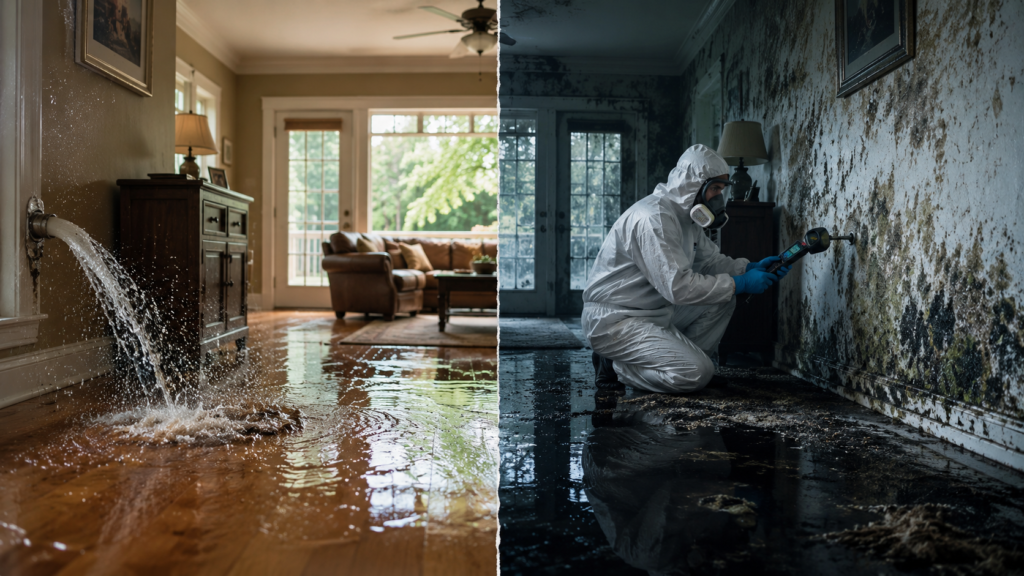
A burst pipe on a Monday morning feels like nothing more than a messy inconvenience. By Wednesday, that same water if left unaddressed can transform your home into a genuine health hazard, one that demands the same level of professional response as a crime scene or sewage overflow.
Most property owners don’t know this until it’s too late.
Water damage and biohazard contamination are two different problems that frequently become one. Understanding where clean water ends and a biohazard begins is the difference between a repair bill in the hundreds and a remediation job in the tens of thousands and more importantly, between a safe home and one that is quietly making your family sick.
This guide explains the escalation process, what health risks are involved at each stage, and exactly when you need to stop treating your water problem as a DIY situation and call in certified professionals.
The Three Categories of Water Damage and Why Category Matters
The Institute of Inspection, Cleaning and Restoration Certification (IICRC), the governing body for professional restoration standards in the United States, classifies water damage into three categories based on contamination level. These aren’t just labels they determine the entire approach to cleanup, the required protective equipment, and which professionals are qualified to handle the job.
Category 1 Clean Water
Category 1 water comes from a sanitary source: a supply line break, a leaking water heater, overflow from a sink or bathtub filled with clean water. At the moment of the event, it poses minimal direct health risk.
The word “clean” can be misleading, though. Category 1 water doesn’t stay clean for long. Once it contacts building materials drywall, insulation, subfloor, wood framing it begins absorbing organic matter and warming up. Within 24 to 48 hours in normal indoor temperatures, microbial activity begins. By 72 hours, what entered your home as tap water has downgraded to Category 2. Left for days, it becomes Category 3.
Speed is the only thing that keeps Category 1 from escalating. Professional extraction and drying within that first 24-hour window can prevent the entire escalation chain.
Category 2 Grey Water
Grey water contains significant contamination bacteria, chemicals, or biological waste products at levels that can cause illness on contact or ingestion. Common sources include washing machine overflow, dishwasher discharge, toilet overflow containing urine (without feces), and HVAC condensate drainage.
This is where many property owners make their most costly mistake. Grey water looks like water. It doesn’t smell like a biohazard. People wade through it, wipe it up with regular towels, and assume it just needs drying out. It doesn’t.
Porous materials that absorb grey water carpet, carpet padding, drywall, insulation cannot be effectively decontaminated in place. They must be removed. Any attempt to simply dry them creates a warm, nutrient-rich environment where bacteria colonize rapidly, often behind walls and under floors where you will never see or smell the growth until it’s extensive.
If untreated, Category 2 water escalates to Category 3 within 48 hours, particularly in warm environments.
Category 3 Black Water (Biohazard)
Category 3 water is grossly contaminated. It contains pathogenic bacteria, viruses, parasites, and potentially toxic substances at concentrations that make direct contact dangerous. This is the official biohazard threshold.
Sources of Category 3 water include:
- Sewage backups and toilet overflows with fecal matter
- Flooding from rivers, streams, or storm surge
- Rising groundwater that has passed through soil and drainage systems
- Any Category 1 or 2 water that has been left untreated for more than 48–72 hours
The pathogens found in Category 3 water include E. coli, Salmonella, Hepatitis A, Norovirus, Rotavirus, Giardia, and Cryptosporidium. Exposure does not require drinking the water. Dermal contact through open cuts or absorption through skin pores, inhalation of aerosolized particles, and accidental hand-to-mouth contact are all documented transmission routes.
This is not a cleanup job. This is a biohazard remediation event.
The 48-Hour Window: When Water Damage Becomes a Health Crisis
The EPA, CDC, and OSHA all agree on the same critical threshold: if wet building materials are not dried within 24 to 48 hours, mold growth should be assumed.
This is not a conservative estimate. It reflects the biological reality of mold spore germination. Mold spores are already present in every indoor environment they exist in the air of your home right now, in concentrations that are entirely normal and harmless. What changes after water damage is not whether spores are present, but whether they have the moisture they need to germinate and colonize.
Here is what happens inside your walls in real time after a water event:
0–6 hours: Water absorbs into drywall, subfloor, and insulation through capillary action. Visible water is only a fraction of what is actually saturating your structure. Hidden saturation is already spreading.
6–24 hours: Mold spores on wet surfaces begin germinating, sending out microscopic root structures called hyphae. No visible growth yet, but the colonization process has started. If water extraction and drying does not begin in this window, mold remediation not just drying is increasingly likely.
24–48 hours: Microbial colonies begin forming. A musty odor may appear. Any Category 2 water present is actively degrading toward Category 3. Carpet, padding, and drywall that have absorbed contaminated water are now significantly more difficult to decontaminate than they were at the 6-hour mark.
48–72 hours: Visible mold may begin appearing in corners, along baseboards, or on wall surfaces. Airborne spore concentrations throughout the property are increasing. Category 1 water events not yet addressed have likely downgraded to Category 2 or Category 3. The scope of professional intervention required has expanded substantially.
Beyond 72 hours: Structural materials are compromised. Mold has penetrated into wall cavities, under flooring, and potentially into HVAC ductwork, enabling it to spread to areas of the property that received no direct water contact. Remediation at this stage involves demolition of affected materials, containment, air scrubbing, and post-remediation air quality testing.
Mold as a Biohazard: The Health Risks Property Owners Underestimate
Mold is not simply a cosmetic problem. Certain mold species that colonize water-damaged buildings produce mycotoxins toxic compounds linked to serious health effects in humans.
The most commonly encountered problem species after water damage include:
Stachybotrys chartarum: (often called “black mold”) associated with mycotoxin production and linked to chronic respiratory symptoms, fatigue, and neurological effects in heavily exposed individuals.
Aspergillus: a genus that includes several species capable of causing aspergillosis, a serious lung infection in immunocompromised individuals, the elderly, and infants.
Cladosporium: one of the most common post-water-damage molds; generally considered less toxic but a significant allergen and trigger for asthma exacerbations.
Symptoms of mold exposure can include chronic coughing and sneezing, respiratory distress, sinus congestion, skin and eye irritation, fatigue, and worsening of existing asthma or allergy conditions. In vulnerable populations children under 5, elderly adults, pregnant women, and anyone with a compromised immune system health effects can be severe.
The critical point for property owners to understand is that mold at a biohazard level is not visible mold on a bathroom ceiling. It is mold that has colonized the interior of wall cavities, the underside of subfloor panels, and the paper facing of insulation places you cannot see and cannot reach without professional equipment and demolition.
By the time you can smell it, the problem has been growing for weeks.
When You Need a Biohazard Team, Not Just a Water Restoration Company
Standard water damage restoration extraction, drying, and structural repair is appropriate for Category 1 events caught within the 24-hour window. A certified IICRC water restoration company handles this competently and safely without biohazard protocols.
But the line between water restoration and biohazard remediation is crossed in several clear situations:
Any sewage backup or toilet overflow with fecal matter. There is no “Category 2” treatment for sewage. It is Category 3 on contact and requires full biohazard decontamination: PPE including respirators and hazmat suits, containment of the affected area, removal of all porous materials that absorbed contaminated water, antimicrobial treatment of structural surfaces, and independent post-remediation verification testing.
Any flooding from outdoor sources. Stormwater, river overflow, or rising groundwater is automatically Category 3 regardless of how clear it looks. It has passed through soil, drainage systems, and potentially combined sewer infrastructure. Treat it as a biohazard from the first contact.
Any water event not addressed within 72 hours. Regardless of the original water category, delay converts the problem. A supply line break discovered three days after it happened is no longer a Category 1 event. Test before assuming.
Any water intrusion following an unattended death or trauma scene. Decomposition fluids saturate flooring, subfloor, and wall materials, creating both a biohazard and structural water damage situation. Biohazard decontamination must occur before any water damage assessment or restoration work. Our team at Hazard Cleanup Phoenix handles this exact scenario regularly the decontamination and the coordination of what comes next.
Visible mold covering more than 10 square feet. The EPA considers growth at this scale to require professional remediation. If your water event has produced visible mold of this extent, you are past the drying stage and into remediation.
What Professional Remediation Looks Like at Each Stage
Knowing which type of professional you need and in what sequence prevents costly errors, insurance complications, and re-contamination.
Stage 1: Source Control (Hours 0–2)
Stop the water. Whether it’s a plumber shutting off a supply line or a municipal authority addressing a sewer main, the source must be controlled before any restoration work begins. Attempting to dry or remediate active water intrusion is counterproductive.
Stage 2: Assessment and Categorization (Hours 1–4)
A certified professional assesses the water category and extent of impact using moisture meters, thermal imaging cameras, and visual inspection. This assessment determines which contamination protocols apply and which materials need removal versus which can potentially be dried in place.
Stage 3: Containment (If Biohazard Is Present)
For Category 3 events and significant mold growth, containment is established before any demolition or removal work. This typically involves plastic sheeting barriers, negative air pressure systems with HEPA filtration, and controlled egress to prevent cross-contamination of unaffected areas.
Stage 4: Extraction and Removal
Standing water is extracted using industrial vacuum equipment. Contaminated porous materials carpet, padding, drywall, insulation are removed and bagged following EPA and state waste disposal protocols. For biohazard events, this work is performed in full PPE.
Stage 5: Structural Drying
Industrial air movers and dehumidifiers are deployed to bring structural materials to acceptable moisture content levels. This process typically takes 3 to 5 days for a residential property and is monitored daily with moisture meters. Temperature and humidity readings are logged throughout to document the drying process for insurance purposes.
Stage 6: Antimicrobial Treatment
All remaining structural surfaces are treated with EPA-registered antimicrobial agents appropriate to the contamination category.
Stage 7: Post-Remediation Verification
For mold and biohazard events, independent testing or clearance inspection is performed to confirm that contamination has been reduced to acceptable levels before reconstruction begins. Skipping this step is a documented cause of mold recurrence and failed insurance claims.
Stage 8: Restoration and Reconstruction
Once clearance is obtained, a water damage restoration company handles structural rebuilding replacing drywall, flooring, insulation, and other removed materials.
For homeowners in other regions dealing with the water damage restoration phase of this process, certified specialists like the team at Akron OH Water Damage Restoration provide the IICRC-certified extraction, drying, and full structural restoration that this stage requires the kind of documented, professional work that insurance carriers accept and that prevents mold recurrence.
A Word on Insurance: Why Documentation and Sequence Matter
Property insurance covers water damage and related losses under specific conditions, and the documentation you create in the first hours after an event directly affects what your insurer will pay.
Key points to understand:
Water damage from a sudden event is generally covered; gradual leaks often are not. A burst pipe is typically covered. A slow leak behind a wall that you didn’t address for six months typically is not.
Biohazard remediation may require separate coverage. Sewage backup coverage is often a rider or endorsement, not standard in base homeowner policies. Verify your policy before assuming.
IICRC certification matters to insurers. Many insurance carriers require that water damage restoration be performed by IICRC-certified companies for the claim to be fully honored. Document the certifications of every company you engage.
Mold that develops from unaddressed water damage may be excluded. If your insurer can demonstrate that mold resulted from your failure to act promptly on known water damage, coverage may be denied. The best protection is documented, immediate professional response.
Photograph everything before any work begins. Get written assessments from every contractor. Keep the moisture readings log your restoration company maintains it is your documentation that the job was done to standard.
Key Takeaways for Phoenix Property Owners
Water damage in Phoenix carries unique considerations. The Valley’s extreme summer heat (with temperatures regularly exceeding 110°F) accelerates Category 1-to-Category 3 escalation dramatically. What might take 72 hours in a temperate climate can progress in 24 hours during an Arizona summer. Monsoon season flooding, which often brings exterior ground water into structures, is automatically Category 3 the floodwater has absorbed everything in the desert soil and urban drainage system.
Act on water damage immediately. Call a professional within hours, not days. Know the category of water you are dealing with before assuming any DIY approach is appropriate. And if there is any question about sewage, flooding, mold, or trauma contamination treat it as a biohazard until a certified professional tells you otherwise.
Leave a Reply